Showing posts with label Boat Work. Show all posts

Friday, 5 March 2021

Just one small boat project...right?!

 One simple project is never just one simple project...


An oil change, a thorough engine room clean, followed by a quick replacement of some rudder bits.  Easy peasy, done in just an hour or two.  Might even have time to do the second engine and rudder, yes?!


Hahaha...you would think after nearly 6 years living on a boat, we would know better.  After all D’s favourite saying is “everything is broken on a boat, we just don’t know it yet”.


We are pros at dropping the rudders having done it a number of times already both in and out of the water.  This is always one’s downfall...overly confident...because this time could we get the rudder to budge?!  Nope.  Hitting it with a mallet got us nowhere.  D trying to pull it down from under water.  Nope.  More hitting it with a mallet....finally it broke free and dropped out.  


What was the problem?!  The smallest amount of growth on the rudder post between the two rudder bearings.  Gah!?  How could such tiny sea creatures cause us hours of frustration?


Okay, beauty, scrape off the growth, replace rudder parts that started this whole mess and reinstalled.  Job well done...


But of course this is not the end to the story.  Mucking with the rudder means, water comes into the engine room and the now newly cleaned engine room is no longer clean and dry.  So just a quick clean, empty out the bilge and then done!  Yes?!  NO!!


Of course not...suddenly the bilge pump that worked just mere hours earlier with the first clean is not working.  Right.  


This is probably a good time to mention that when I say engine “room”, it is a bit misleading.  It is an area where the engine takes up the vast majority of the space with perhaps a foot of clearance around the perimeter of the engine.  This means trying to access anything on the bottom of this said engine “room”, involves D straddling the engine and basically lying on the engine with his head and shoulders upside down.


And of course any appropriately located bilge pump is in the deepest, darkest recesses possible.  D manages to remove the pump.  From my perspective, I swear he only waved the screwdriver over it and voila like the magician he is, we have a functioning bilge pump again.  Whew!  That is one spare we don’t have and to buy any spares here in French Polynesia basically requires the need to mortgage the boat. 


And for today?!  The second engine oil change and rudder will have to wait for the pain of yesterday to fade.  But not to worry, D did have to fix the outboard engine when it sputtered and died on the girls and I, so he did not get the day off of fixing broken stuff.


Thursday, 9 February 2017

Photo Journal of Our Atlantic Crossing

The Preparations - Provisioning

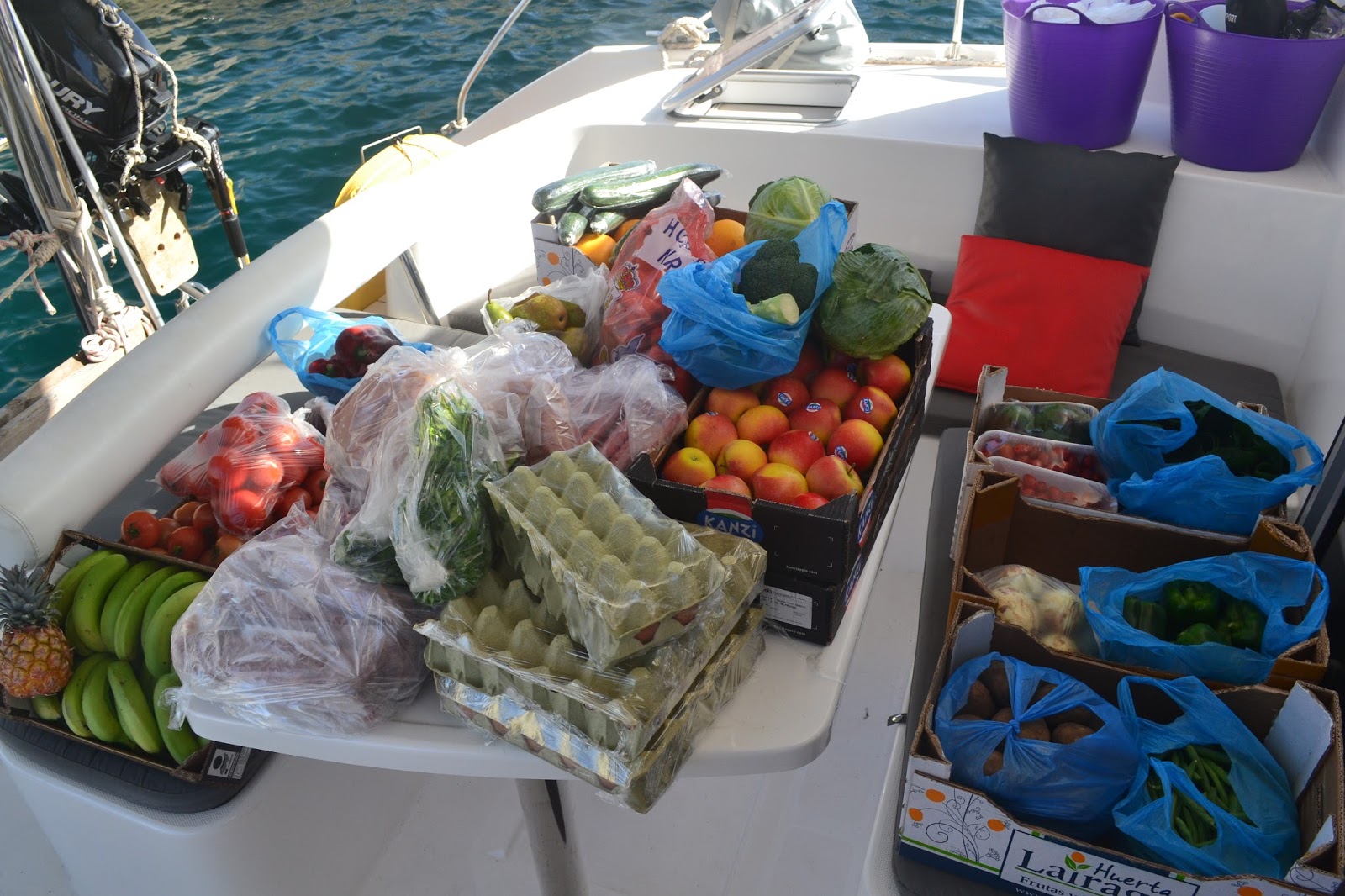
So how do you prepare for a three to four week crossing for four adults and two children when you have no opportunity to run to the store for that forgotten ingredient?!  A lot of money, loads of trips to the stores to identify what we want (but thank goodness the major stores deliver!!!!), and plenty of creativity on where to store it all on the boat (nothing like using a spare shower stall to store produce).  The water line was getting lower and lower by the day.


Logo Painting

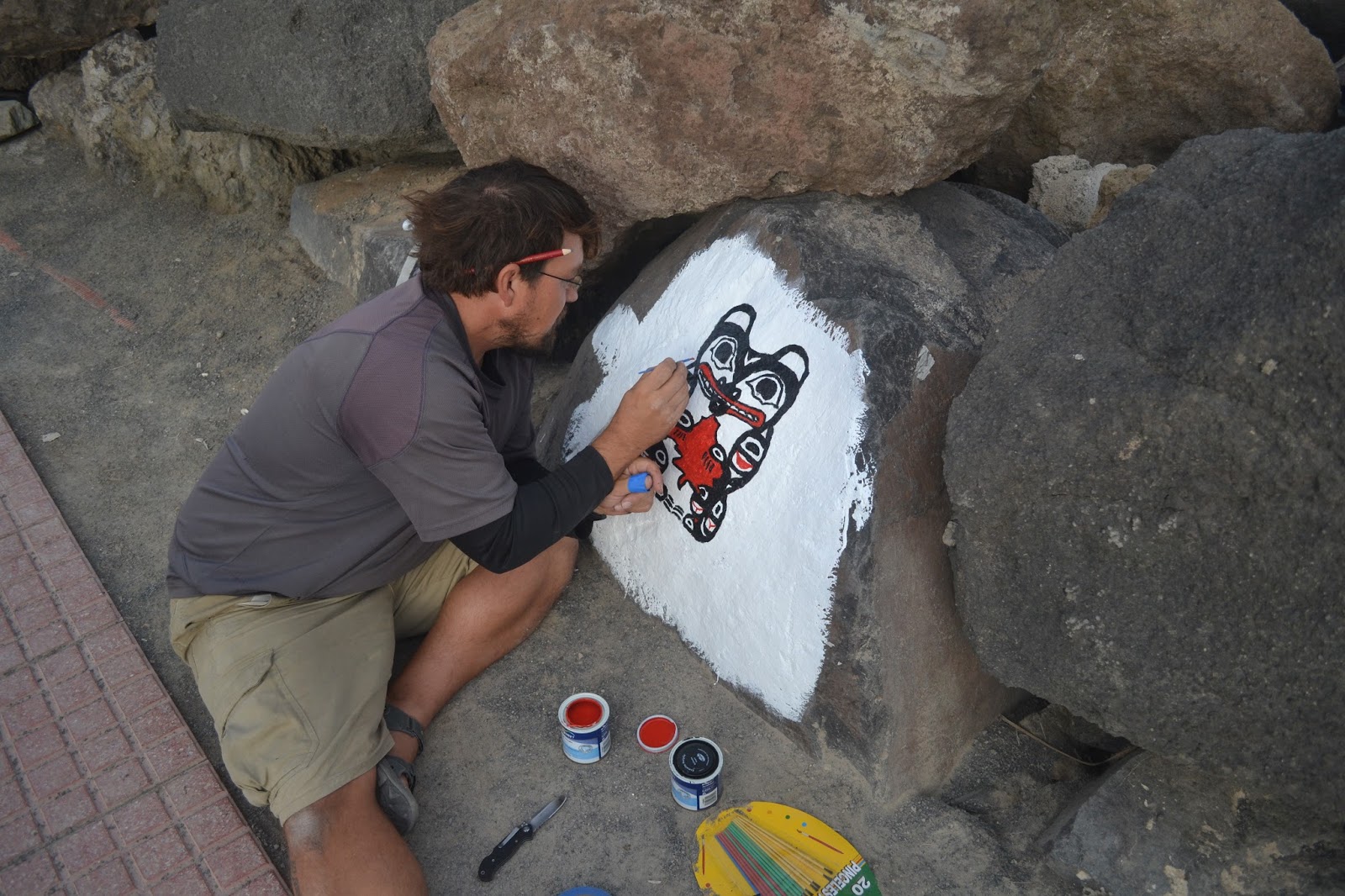
As though we didn't have anything else to do just prior to departure, Darryl was insistent that we leave our mark in Las Palmas.  It seems to be a tradition for departing boats to paint a logo on a rock or wall in the marina.  Despite our imminent departure date, Darryl and the girls managed to paint our logo on a rock to commemorate our first ocean crossing.


Departure Day

For as long as we have been planning the Atlantic Crossing, we have had January 10 as our intended departure date for some unknown reason.  However, for all of December and early January, we were experiencing highly unusual weather.  Usually at that time of year, the trade winds are well set in and everything is very predicable.  Instead, the weather was very unsettled and the winds coming from the opposite direction.  It was delaying loads of boats in leaving.  We kept our eye on January 10 but figured it likely would be a later departure date.  But sure enough as January 10 approached, the weather was changing and the winds were turning to the more usual NE direction.  And wouldn't you know it, we were all ready and left on January 10!!!  

So the morning of, we had our crew briefing and the raising of our crew flag and we were set to cast off the dock lines.


Things To Keep Us Occupied

So what do you do for three weeks when restricted to an 11.5 meter x 6 meter floating platform?  Surprisingly a lot!!!

First and foremost, the four adults rotated on a 2 hour watch schedule all day and night.  While Ella took the 1400 to 1600 watch every afternoon.  I could not be more proud of Ella for being committed to her watch.  The only watches she missed were on the first day when we were only a couple of hours out of Las Palmas and she wasn't feeling great, and the last day, with all the excitement the watch schedule went out the window.


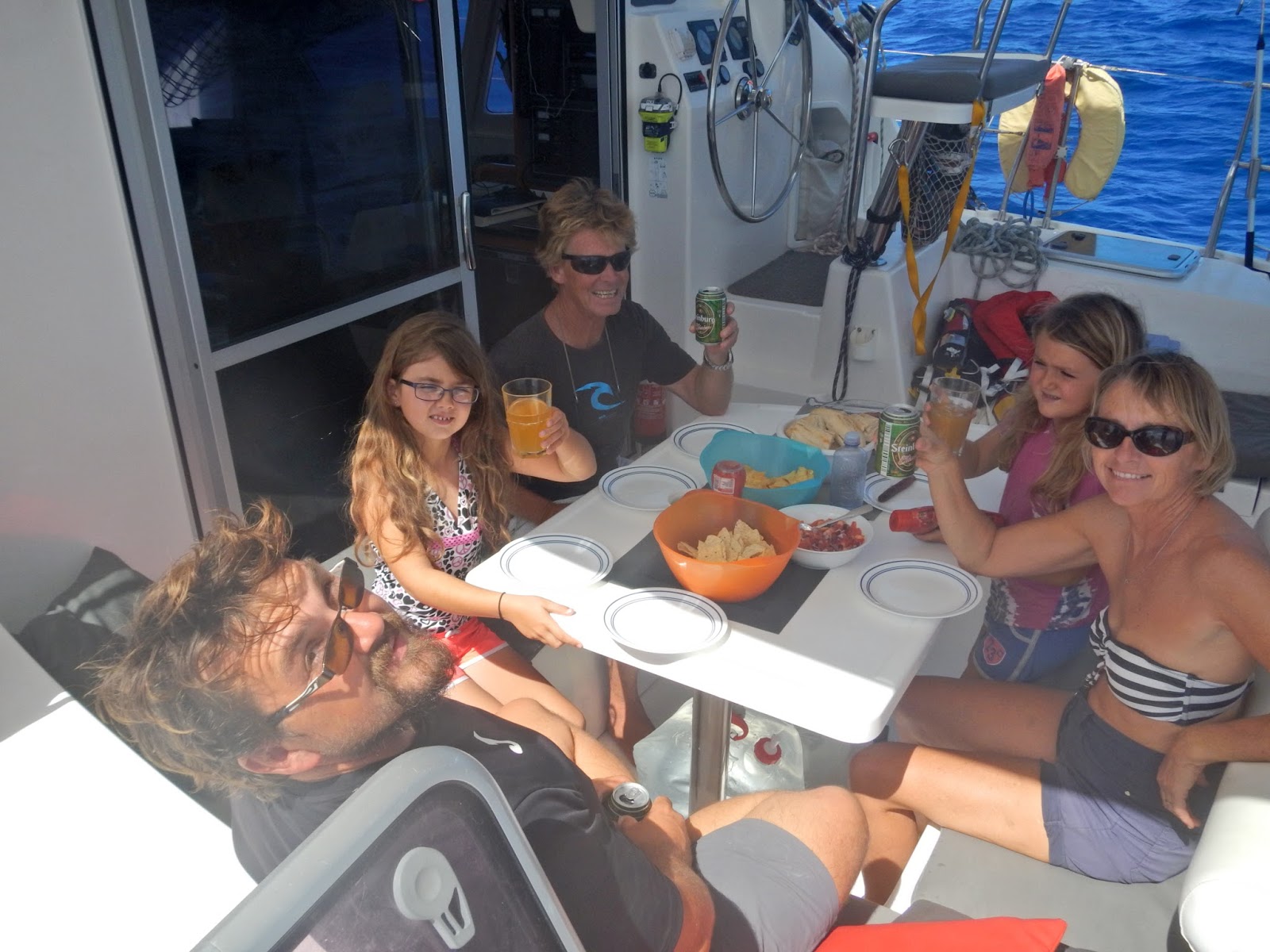
Any excuse for a celebration, which on Maple involves food and the smallest bit of imbibing.  Crepes and cava to celebrate the halfway mark.  And sausages and beer to celebrate Australia Day!


Knitting (can't thank Sandra enough for her amazing patience!), dress up, cleaning (huge thanks to Jeff for cleaning the rust stains around all the stanchions), boat repairs (sadly no pictures of Darryl clinging for his life to the mast), and reading, reading and more reading....


School For All!  Darryl involved the girls in charting our course on the chart.  We did a unit on Christopher Columbus.  And even Jeff and Sandra got in on the action with Darryl teaching them how to splice rope and make soft shackles.  


Fishing!!!  We had a tough start after losing four lures, plus five catch and release of small tunas.  But our persistence paid off on Day 9 when we reeled in a beautiful 13kg yellow fin tuna.  So of course dinner that night was SUSHI!!!  Since our freezer was already full of meat purchased prior to departure and then the addition of the tuna, we did not fish for awhile.  

On the morning of Day 15 with prompting from Jeff we cast the lure once again.  And within an hour Jeff had reeled in a gorgeous dorado (aka: mahi mahi)!!!  


Lots of scenery that looks like this:


Where is all the evidence of all that amazing wildlife we experienced??  In video format of course and that takes WAY more effort to edit than throwing up a few pictures on a blog post.  So with enough nagging perhaps I can get Darryl do it, otherwise, we might all be waiting awhile before I figure out how the heck to edit out hours of video of boring seas for the 5 second blip of a whale breaching or dolphins playing in our bow waves.

Arrival

After 20 days out of sight of land, on Day 21 land was spotted!!!!  And after 21 days and 9.5 hours, we dropped anchor in the Caribbean after leaving from the Canary Islands.


The girls wasted no time jumping in the water, at the same time we watched the first sunset in the Caribbean on board Maple.  We have not been in the water since early October off the coast of Spain, so the white sand beaches and warm waters are glorious.


How do you begin to thank two people who took four weeks in their lives to help us safely bring our home and family across an ocean?!  Any words seem inadequate, so I just hope Jeff and Sandra know how much gratitude we will forever have to them.  I could not imagine this experience without them being part of it.  Much love and thanks to you both!  xoxo


Friday, 11 March 2016

More boat work drama...

The day starts off well, just like any other day on the hard.  The sun was shining and we're living the dream in Turkey.  I've got a list of boatwork to complete and I've actually got the supplies and tools to do the job.  It's going to be a good day.

Then I hear Janet call out; "Why is the bilge pump running?"

I don't think I need to tell you how unfortunate, and unlikely it is to have a bilge pump run while the boat is on dry land...

Good news - we're not sinking.  Bad news - we have a ton of water gathering in our starboard bilge.

Working together to frantically tear through bilge lockers and identify the source of the water we arrive at the hot water heater under our bunk.  Hmmm...looks good.  Wait - that spray of water shouldn't be there...where's it coming from?

A few moments of feeling like a blind man at a water park and I locate the leak.  It's the freshwater feed for the heater.  More good news - we were planning to disconnect this heater anyway since we really don't need two on a boat our size.  I disconnect the pipes and call it a success.  I'll remove the pipes later I tell Janet,

Fast forward six weeks.  We've been back in the water for nearly two weeks with no water in the bilge - which is a big plus for us since I did so much work on former and current thru-hulls.  I'm happily neck deep in some other boat task when I hear Janet call me.  "We have water in the bilge!"  

While Janet traces the source of the water I quickly taste it.  Fresh.  Thank god.  That means no major hole in the boat - we're just draining our water tank into the sea.  We pump the bilge out and then begin troubleshooting.

The culprit?  That damn hot water heater.  Since getting back in the water any time we've used the faucet in the starboard head, water has been pumping cold water out of the tank and through the decommissioned (but still connected) hot water hose into the bilge under our bunk.  It looked something like this:


Lesson learned.  Never leave a boat job half finished.


Wednesday, 9 March 2016

Things that go bump in the night.


Even as relative neophytes in the sailing world, Janet and I knew starting out that it's not wise to ignore strange noises.  Our experiences since July have reinforced our instincts in this regard.  That's why we decided we had waited long enough to address the strange thumping noise that could be heard in the boat whenever we anchored and there was any swell or current.

The noise first appeared in the days after we took possession of Maple.  At anchor we heard a consistent thumping sound that seemed to come from the area of the rudders.  A cursory examination suggested that the rudders were moving slightly in the swell in spite of the steering being locked.  Not ideal but our surveyor had investigated the play in the rudder prior to purchase and proclaimed it ok.  Surveyors are never wrong are they?  

Not willing to take his word for it, I contacted Robertson & Caine, the makers of our boat.  They suggested that at 5 years old, the rudder bearings may be worn and need replacement but that the movement was not something to be concerned about and the consensus on the sailing forums seemed to be that worn bearings were not a critical replacement item and could be addressed at the next regularly scheduled haul out.

We spent the next 6 months sailing, anchoring and growing accustomed to the thumping and bumping emanating from the rudders.  "How bad could it be?" we asked ourselves, while at the same time checking to make sure the rudders were still in place after every heavy workout we gave them. More digging online revealed that many other Leopard owners had experienced water intrusion in their rudders to the point where the interior core of the rudder was compressed and the rudder tangs moved within the blade.  


Maple's rudder construction.

This revelation introduced a new level of anxiety into our cruising for the remainder of the year and we agreed that we would make dealing with the rudder question a priority when we stopped in Turkey for the winter.  This would mean hauling out when the boat had already been out in February and had the bottom painted, and then again in October to replace saildrive seals.

Pre-haulout discussions with other cruisers identified a third possible reason for the play in the rudder; loose steering linkages.  After checking the linkages we considered this a remote possibility with the bearings being a possible cause and play in the rudder core/tang the most likely.  In order to confirm this the plan was to:

1- Drop the rudders when we hauled the boat
2 - Check the rudder bearings for excessive play side to side and up and down
3 - Cut small sections of the rudder to assess the degree of water intrusion and possible cause of the rudder movement

Dropping the rudders with help from cruising friends.

With the rudders dropped it was apparent, even before cutting into them that the problem was not the bearings or the steering linkages.  When gripped and turned, the rudder stock moved independent of the blade which is never, ever, a good thing.  In order to turn the boat the stock and blade must behave as if they are a single unit, anything else means that steering may not work when you need it most.

It looked like I would be opening up the rudders after all.  I needed to have a look to understand what was allowing the rudder stock to move.


Rudders opened up for inspection.

With some exploratory surgery completed I had my answer and it wasn't good.

The rudders are constructed using a 38mm diameter stainless post, this has 3 10mm diameter holes drilled through it which hold 3 tangs which are essentially 10mm steel bars.  Each of the tangs is encased in resin of some kind (probably vinylester).  The rudder is essentially 2 halves of cored  end grain balsa skinned with fibreglass which are stuck together with a resin layer in the middle that holds the tangs.

Unfortunately, the construction while robust, heavy and nearly bullet-proof was not completed well and there were major voids in the resin layer at the centre of the rudder.  In addition, a gap around the rudder post allowed water to enter the rudder and pool in these voids.  The end result was rotting of the balsa core in the top 1/2 of the rudder and crevice corrosion in the top 2 of 3 tangs.  Combined with the fact that the tangs were not welded to the stock and allowed to float and flex (read metal fatigue) this corrosion was bound to result in something breaking.

Both rudders had exactly the same issue.


For 6 months we had been sailing (sometimes in pretty heavy seas) with rudders that had lost 2/3 of their ability to move the boat.  Scary stuff.

After some discussion with a shipwright we met in the yard we landed on a fix.

1 - Carve out remaining rudder tangs
2 - Expose rudder stock for repair
3 - Insert new tangs in stock
4 - Weld tangs to stock to eliminate potential for metal fatigue
5 - Add plates to tangs to provide greater bearing surface within rudder (probably unnecessary)
6 - Fill rudders around new tangs with epoxy mixed with chopped fibreglass matt and cabosil filler
7 - Apply 2 layers of fibreglass to rudder to encapsulate and complete repairs
8 - Grind channel in top of rudder around stock and apply thick bead of Sika 292 (3m 5200 equivalent) to try to eliminate potential water intrusion at this critical flex point
8 - Barrier coat rudders
9 - Bottom paint rudders

And so the work progressed with assistance from Jeff on Nawii I got the rudders cut open completely and was able to get the welder at the yard to fabricate and attach the new tangs.


All that remained was to close it all up again.


The good news?  The rudders were very very hard to cut open and clean out.  These are strong little guys and generally well constructed.  Also, on a catamaran the rudders are not subject to the same loading as on a similar sized monohull, weather helm is not as significant and there is limited foiling effect. 

A combination of water intrusion/corrosion and metal fatigue are likely the cause of our problems.  I believe we have addressed these issues, and I now know exactly how the rudders are constructed and what to watch for.  

And along the way I've learned a lot about fibreglassing and other critical boatyard skills.

Tuesday, 8 March 2016

Maple's Mini Refit

Since we haven't posted much about our journey lately, many readers may not know that Maple has just recently re-entered the warm waters of the Mediterranean after an extended boatyard stay.

We had a fantastic summer cruising in Maple and she has been good to us, but being newly retired from chartering, and with our composting head upgrade completed there were a few things we wanted to take care of that meant we needed to get out of the water.

Here's the list of boat jobs completed by myself, Janet and the kids during our first mini refit. We can't compare it to our planned jobs because the list kept changing and growing as we found new things that would only take a minute.*

*Those that have ever owned a boat know that there is not one single boat job that ever only took a minute...

1 – Dropped rudders, checked rudder bearings
2 – Rebuild rudders (more on this in another post)
3 – Serviced Saildrives including oil & zinc changes
4 – Made new rubber flaps for the saildrives and installed said flaps
5 – Remove 3 below water thru-hulls
6 – Remove 2 above water thru-hulls
7 – Fibreglass 5 thru-hull holes
8 – Filled void discovered in starboard bilge (it held about 1/2 litre of smelly water)
9 – Gel coat & colour match 2 above water fibreglass repairs
10 – Replace 1 below water thru-hull
11 – Repair grounding damage on starboard keel (this was not our damage – the repairs done prior to our purchase were not as complete as we thought)
12 – Applied new anti-foul, raising the waterline about 2 inches (no – we're not that heavy, but it needed to come up about 1 inch and we're trying to avoid the brown scummy moustache by going a bit higher)
13 – Painted new bootstripe (both due to the higher water line and to cover the Sunsail blue
14 – Painted over cove strip (to hide the Sunsail red)
15 – Repaired damage on port transom (also from former charter days)
16 – Removed and properly attached transom rub-rails both port and starboard
17 – Cleaned transom rub rails & bimini rub rail
18 – Cut polished hull
19 – Waxed hull
20 – cut polished sides of cabin top
21 – Attached Maple logo to sides of cabin top
22 – Replaced stern u-bolt capsize attachement points
23 – Cleaned fenders
24 – Painted anchor roll bar to improve visibility
25 – Scraped porthole frames in preparation for painting (I'll get these painted while we're in the water)
26 – Removed sail for cleaning and repairs
27 – Had new lazybag made for sail (getting rid of the rotting fabric which was also Sunsail blue)
28 – Made drainpipes for bimini which should allow us to catch rainwater for our tanks and will also minimize the amount of water that drains directly onto our engine room hatches (and the path to exit/enter the cockpit)
29 – Disconnected starboard hot water heater from water system due to a cracked feed pipe which caused our bilge pump to run WHILE THE BOAT WAS SITTING 2 FEET OFF THE GROUND!
30 – Replaced feedline in port hot water heater which cracked no more than 2 days after the starboard pipe (in exactly the same place with exactly the same result – at least we know the bilge pumps work).
Dropping the rudders with help from friends.

The rudder rebuild begins...

Thru-hull patch, complete with newly discovered voids...
Rubrail grime - before.
Rubrail Grime - gone!

Coat 1 of 3...
Jeff from Nawii works on finishing touches.

Maple Before - Ready for some TLC.
Maple, pretty and proud and ready to be back in the water.

We were pulled out of the water on February 2 and dropped back in on February 29 giving us just shy of 4 weeks to complete all of this work...which translates to a bit more than one thing every day...wow – not too bad when I think of it that way.

In case you were worried, we haven't been idle since getting back into the water. Here are the additional jobs that we've completed in the last week.

1 – Changed fuel filters (both primary and secondary)
2 – Changed engine coolant
3 – Cleaned engine rooms (man they were gross)
4 – Changed raw water impellers
5 – Changed cover plates on raw water pumps which we noticed were significantly scored when we were checking the impellers
6 – Applied Vaseline to exterior deck hatches, normally this is not recommended as the Vaseline, being petroleum based will degrade the rubber, but it also causes the rubber to swell and I'm hoping this swelling will help seal the hatches.
7 – Installed new mast cleat to replace one I broke being dumb
8 – Completed disassembled, cleaned, reassembled and properly lubricated 4 winches (I think Sunsail's version of servicing was just to pack as much new grease as possible onto the dirty old grease.)
9 – Emptied and cleaned composting heads
10 – Complete scrub-down of exterior deck (it was grimy from the boatyard) and interior (also grimy from the boatyard)
11 – Repaired snap on helm seat cushion
12 – Washed mainsail and sent for minor repairs
13 – Ordered new spinnaker for delivery before we head out in April
14 – Met with carpenter to design and order new salon table that folds which will allow our salon to also feel like a living room rather than having us sitting at a big dining room table all the time.
15 - Cut new mirrors for the bathrooms

Winch Servicing - long overdue.

Whew – we're exhausted just re-reading what we've accomplished and are optimistic that we won't need to do this much work in one go for a while. That said, boat jobs never really end it seems.


Through all of this, the girls were remarkably resilient. School occured as planned nearly every week day. Many days they worked in the marina's club-house (called the Port Hole) and on others in the salon while Janet and I laboured on either helping them with school or getting a boat job done.  When not in school they played with other kids at the Marina or entertained themselves in the boatyard.

Take your child to work day...
The girls have turned into boat kids - a boat in the slings means it's limbo time!

They were also very helpful in cleaning, and reinstalling fenders and keeping the jobsite tidy, picking up all the little bits of trash that I left lying around.

At the end of the day, what matters is that we're currently bathed in sunshine, it's 20 degrees most days and the summer sailing season is about to begin. We love Finike and our Marina friends but are itching to get moving again and looking forward to having the girls Grammie with us as we head North in April.